The Graph That Goes Down and to the Right
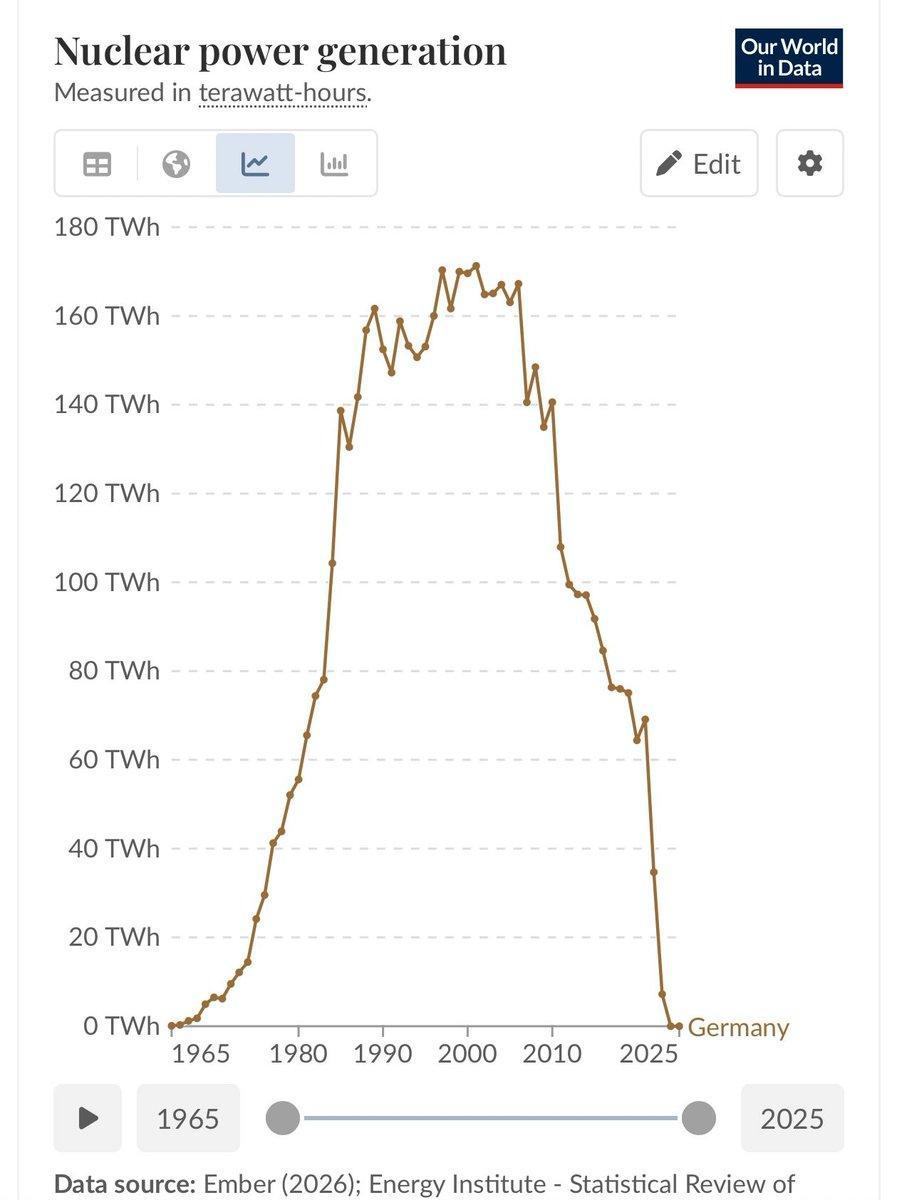
Germany nuclear power generation, 1965–2025. Source: Our World in Data / Ember (2026)
Germany shut down its last nuclear plant in April 2023. The graph of their nuclear output tells the whole story without a single word of explanation. Peak production around 170 terawatt-hours in 2001. Then a long, deliberate decline. Then zero.
Every time you see a graph that goes down and to the right, it is failure. This one is no different.
The German decision to phase out nuclear power was not forced on them by economics or physics. It was a choice. Energiewende, they called it, the energy transition. The plan was to replace nuclear with renewables: wind, solar, ambition. What actually happened was different. When the sun did not shine and the wind did not blow, they burned coal. They burned gas. They imported electricity from France, which generates most of its power from the nuclear plants France did not shut down.
Germany eliminated its cleanest, most reliable baseload power source and replaced it, in practice, with Russian natural gas and lignite coal, one of the dirtiest fuels on earth. The carbon emissions that were supposed to fall went up. The energy prices that were supposed to stabilize became among the highest in Europe. The energy independence they were reaching for collapsed into dependency on a country that would invade a neighbor four years later.
Fukushima was the political trigger. The 2011 disaster in Japan convinced Angela Merkel’s government to accelerate the shutdown timeline. But the sentiment was already there. German public opinion had turned against nuclear in the 1970s and 1980s, hardened by Chernobyl, and never fully recovered. Fukushima gave the policy permission to finish the job.
The problem with making energy decisions based on fear rather than physics is that the physics does not care about your feelings. Nuclear power plants produce electricity when you need it, not when the weather cooperates. They produce no carbon during operation. They require a fraction of the land that wind and solar demand. And the waste they generate, while genuinely problematic, is small in volume compared to the waste streams of fossil fuels, which we simply emit into the atmosphere and call it someone else’s problem.
Germany made a values-based decision and paid an economics-based price.
Now the context has shifted again. Artificial intelligence is hungry. The data centers running large language models consume electricity at a scale that would have seemed implausible five years ago. Goldman Sachs projects that data center power demand will grow 160% by 2030. Microsoft, Google, and Amazon are all signing nuclear power agreements they could not have imagined a decade ago. Microsoft restarted Unit 1 at Three Mile Island specifically to power its AI infrastructure. The plant that became synonymous with American nuclear anxiety is now powering the future.
Every major tech company building AI capacity at scale is quietly doing the math and arriving at the same answer: reliable, carbon-free baseload power is the constraint, and there is only one technology that delivers it at the required scale. Nuclear.
France kept its plants. France exports power. France has among the lowest grid carbon intensity in Europe and electricity prices that German manufacturers have been quietly moving their operations toward for years.
There is a lesson here that applies well beyond energy policy. When you make decisions based on what feels right rather than what the evidence supports, you do not escape the evidence. You just encounter it later, at higher cost, with fewer options.
Germany will spend the next decade trying to undo what it spent the previous decade doing. Some of that capacity is simply gone. Nuclear plants are not like factories you can mothball and restart. The engineers retire. The supply chains atrophy. The institutional knowledge disperses. You do not just flip a switch and resume from where you left off.
The graph that goes down and to the right is not just an energy story. It is a cautionary note about the cost of ideological consistency in the face of inconvenient facts. The world needed more clean power. Germany had it. They shut it down anyway.
Now they are rebuilding from a lower floor, in a world with higher stakes, in a race they chose to start behind.
Andrew Perkins is the author of After the Grind: Rethinking Your Business Career in the Age of Artificial Intelligence and Robotics and Chair of the Department of Marketing and International Business at Washington State University’s Carson College of Business.
Get essays like this in your inbox
New essays on AI, education, and the future of work. No spam, unsubscribe anytime.